What are the entry requirements?
You’ll need a grade 4 in GCSE English and a grade 6 in GCSE Maths. You will need a GCSE average of 5.4. You don’t need to have studied GCSE Information and Communication Technology (ICT), and very few students have programmed before, as programming is taught from scratch. You’ll also complete transition work over the summer and hand it in at enrolment.
What will you learn?
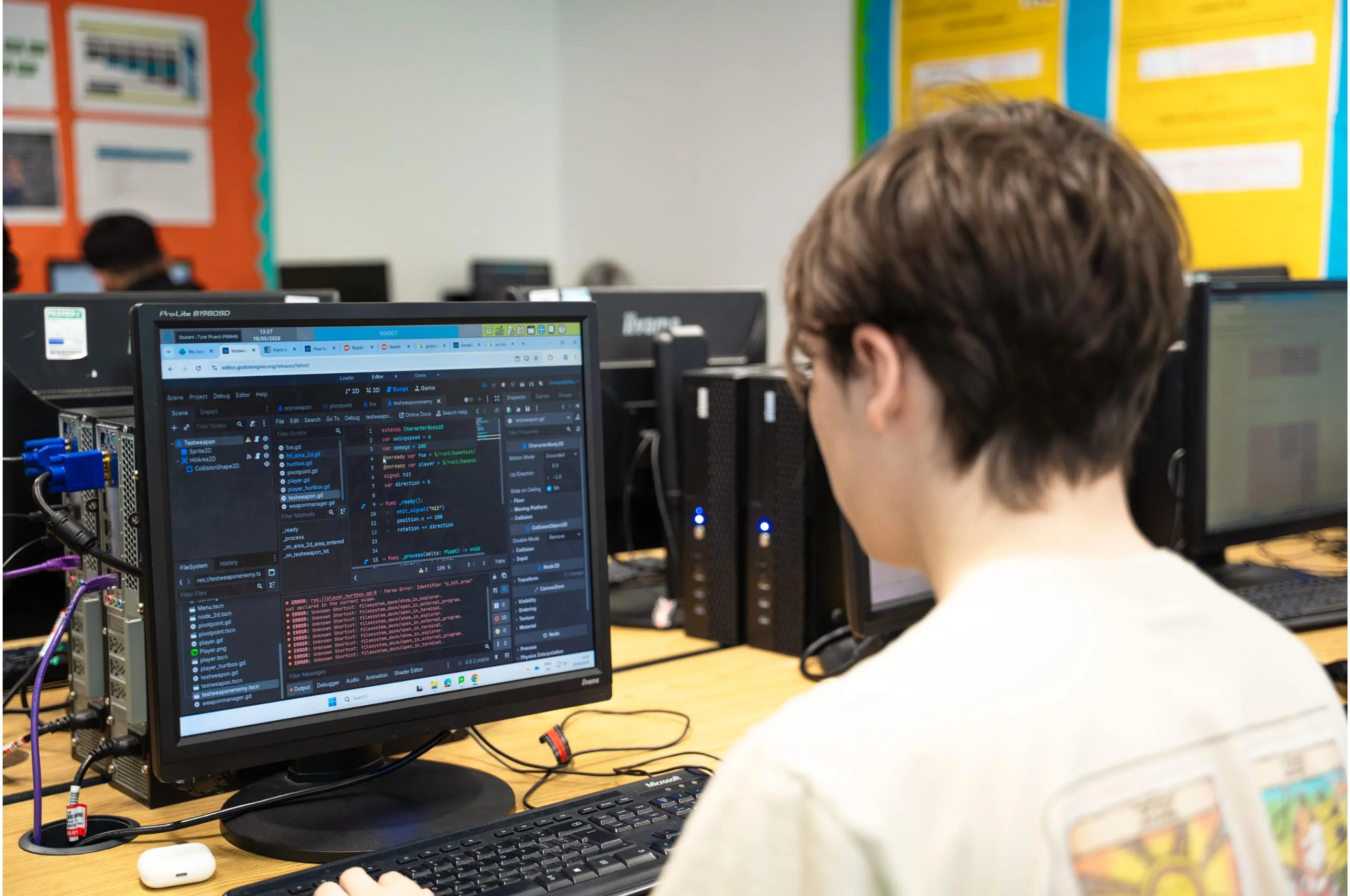
You’ll explore the fundamental principles of computer science, including abstraction, decomposition, logic, algorithms and data representation. Programming forms a big part of year one, helping you understand key ideas like searching and sorting. You’ll also study how processors and software work, how data is stored and exchanged, and the legal, moral, cultural and ethical issues around computing. In year two, you’ll design and build a computer-based system of your own choosing as your programming project. Assessment is two written papers, each two hours 30 minutes and worth 40% of your A-level, plus your programming project, worth 20%.
Is Computer Science right for me?
It is if you enjoy problem-solving, logic and building things that work. It’s very different from an ICT course: Computer Science is about how computers work and how to program them, while ICT focuses on using software packages and managing data. You’ll work on your own and in teams, just like real-world programmers, with around 4.5 hours of classroom learning and 4.5 hours of independent study each week. And it’s a subject for everyone: girls are very welcome, and many advances in computing have involved women.
What can this course lead to?
You could take a degree in Computing or Computer Science, or a more focused degree such as Software Engineering or Artificial Intelligence, and Computing graduates hold a very marketable degree. If you’re aiming for a Computing degree at one of the top universities, you’ll usually need A-level Mathematics too, so it’s worth thinking about that combination early. Computing degrees don’t demand A-level Computer Science itself, but studying it is a great way to find out whether it’s the subject for you.